Phase 3 · The Launch Service · Operational by Late 2031
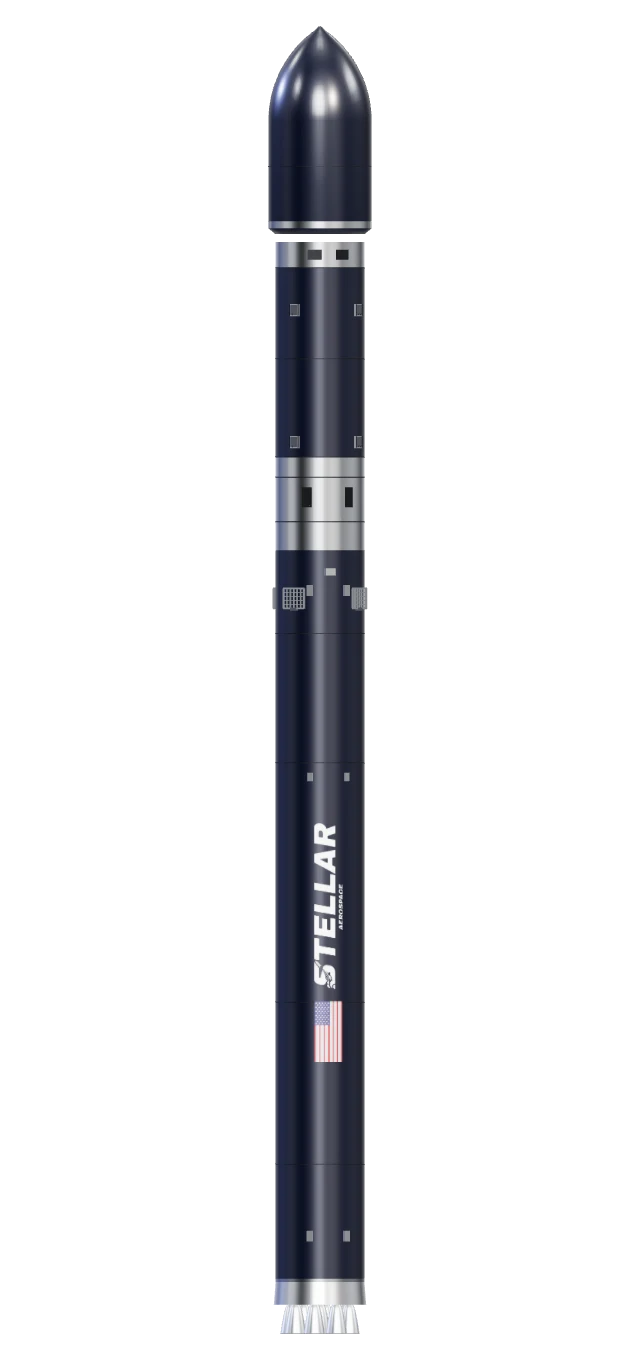
Lightning is the rocket Stellar exists to build. Both stages and the fairing come back after every flight, so we are not building a new rocket for every launch. That is how we can offer a flat $5,000 per kilogram, take bookings online and fly twice a week.
Phases 1 and 2 exist to retire the risk on the way here. See How
Lightning
Loading the vehicle…
01 / 12
Lightning
Our commercial launch vehicle. Two stages, both recovered and flown again, delivering up to 2,750 kg to Low Earth Orbit at a flat $5,000 per kilogram. Built to fly twice a week from one hangar and two pads. Operational by late 2031, on the Tuesday and Thursday schedule by 2032.
The Product
02 / 12
Nine Phoenix Engines
Stage one lights nine Phoenix engines, the largest of our three engine generations. Phoenix burns liquid methane and liquid oxygen, cools its chamber and nozzle with its own fuel (regenerative cooling), is fed by battery-powered electric pumps and, like every Stellar engine, is 3D printed in Inconel 718, so we can produce engines at fleet volume, swap worn parts quickly and keep the cost of every flight down.
9 × Phoenix
03 / 12
Stage Separation
High above the atmosphere the stages unlatch. Stage two lights three vacuum-optimized Phoenix engines, with larger nozzles than the sea-level engines below, and keeps climbing toward orbit while the booster coasts away beneath it.
3 × Phoenix Vacuum
04 / 12
The Booster Turns Back
Stage one flips end over end, unfolds four grid fins for steering and fires a boostback burn. It is now flying home to the same site it launched from.
Grid Fins and Boostback
05 / 12
Caught by the Tower
There are no landing legs to carry to orbit. The booster slows on its engines and the tower arms close around two catch pins. It is lifted off the arms and back into the hangar for its next flight.
Tower-Arm Catch
06 / 12
Second Stage to Orbit
Stage two carries the payload the rest of the way. The upper stage, its engines and its hinged fairing are all designed to come home, so nothing on Lightning is thrown away.
Fully Reusable
07 / 12
The Fairing Opens
The fairing is hinged to the stage instead of being jettisoned. Its two halves swing open in orbit and close again before reentry, so they land with the stage and fly again.
Hinged Fairing
08 / 12
Chameleon
Chameleon is the payload rack on the second stage. Each satellite or CubeSat dispenser arrives with a Fly or Dragonfly Adapter already fitted, and we click it onto the rack with over-center latches. The same rack carries up to 50 small satellites, a large primary with rideshare below it, or one satellite of up to 2,750 kg.
Separation springs push each payload off the rack, with no pyrotechnics. Satellites on the sides of the rack release first, and a primary on the top deck follows about 60 seconds later. Payloads booked with the cold gas layer get a small push of their own to clear the stage and make fine adjustments.
Spring Separation
10 / 12
Close and Come Home
With the rack empty the fairing swings shut on its hinges. Stage two turns broadside and leads with its heat shield through reentry: a custom-made PICA ablative shield on the windward side of the stage and fairing that clicks in before flight and is swapped for a fresh one after every landing.
Swappable PICA Heat Shield
11 / 12
A Guided Descent
Once the stage has slowed, a steerable parafoil opens and flies it home under GPS guidance. The recovery arena can be approached from eight directions, so the stage always lands into the wind. As it closes in, it lowers a hook on a line. If a crosswind pushes it off line, short bursts from its cold gas thrusters steer it back toward the arena.
Steerable Parafoil
12 / 12
Hooked and Netted
The hook snags an arresting cable and the parafoil is cut away. Shock absorbers in the masts pay out cable to bring the stage to a stop while its cold gas thrusters hold it in a hover, then the thrusters taper off to lower it softly into the net. Both stages are back and turned around within 48 hours, ready for the next booking.
Arresting Cable and Net
Why Fly Lightning
Small satellites are being built faster than the world can launch them, and most of them still ride as secondary payloads on someone else’s schedule. Lightning is designed around the customer who needs a specific orbit, a near date and a price they can plan around.
Payload to LEO
2,500 kg
shared across the Chameleon rack
Single Large Satellite
2,750 kg
whole vehicle, flat $13.75M per flight
Price
$5,000/kg
shared flights, 50 kg minimum per customer
Cadence
2 per week
about 104 flights a year
Turnaround
48 hours
dual pads, one hangar
Engines
9 + 3
Phoenix, methalox, electric pump-fed, regeneratively cooled
Program Development Budget
$250M
R&D, hardware and room for many failures
Book It Like a Flight
Pick a date, a mass and an orbit in our online booking portal, with an API for teams that schedule many launches. Published prices mean a quote takes minutes, not months of negotiation.
Launch When the Mission Needs It
Two flights a week means a satellite that is ready does not wait a year for a seat. That flexibility is what Tactically Responsive Space needs, and it is what commercial operators with a growing backlog of small satellites are short on today.
Fit One Adapter, Ship the Satellite
Order a Fly or Dragonfly Adapter from us and fit it using the checklist we send with it. Ship the satellite, or your CubeSat dispenser, with the adapter mounted, and we click it onto Chameleon. Adapters are made in volume at one fixed price, and each one leaves with its satellite. Flying CubeSats? We can also supply a CubeSat dispenser with the Fly Adapter already mounted, so you only ship us your CubeSats.
Chameleon Payload Rack
One rack on Lightning's second stage, rebuilt for each flight. A modular spine holds rideshare satellites around its sides, and a movable top deck, the Upper Stump, carries a larger primary. Every payload connects through the same click-on adapter, so the rack changes shape without new hardware for each customer.
Logistics
The full spine, with up to 50 small satellites and/or CubeSat dispensers mounted around it, each on a Fly Adapter. Up to 2,500 kg in total.
Hybrid
The Upper Stump sits partway up a shorter spine. A primary rides on top on a Dragonfly Adapter, with rideshare satellites below it on Fly Adapters.
Heavy
The spine comes off and one satellite of up to 2,750 kg rides on a Dragonfly Adapter. The customer buys the whole vehicle and picks the orbit.
Every payload rides on a Fly Adapter or the larger Dragonfly Adapter. It is the only hardware we ship you: fit it with our checklist and send the satellite back with it mounted. If you book the optional cold gas layer, we fit it between the rack and your adapter, and it gives your satellite a small push of its own to clear the stage.
PICA Ablative Heat Shield on Stage and Fairing, Swapped Each Flight
Recovery
Steerable parafoil, hook, arresting cable and net
Landing Thrusters
Cold gas, used only to land: crosswind trims, a hover after the cable catch, and a soft drop into the net
Fairing
Type
Two halves hinged at the base
In Orbit
Opens to release payloads, closes before reentry
Recovery
Lands with stage 2 and flies again
Engine thrust, specific impulse and vehicle mass will be published once Spark's flights confirm them. Payload User's Guide (PDF)
The Gap Lightning Fills
There is a backlog of small satellites waiting for a ride to orbit. Large rockets carry them as rideshare, on the date and to the orbit their main customer chose. Small dedicated rockets fly on the customer's schedule, but carry too little to bring the price per kilogram down.
Lightning is built for the space between them: up to 2,750 kg per flight, its own fixed schedule every Tuesday and Thursday, and a published price of $5,000 per kilogram. It adds launch capacity for satellites that today wait for leftover room on someone else's rocket.
The Launch Backlog
Small satellites are being built faster than there are rides for them. Most still fly as secondary payloads on large rockets, on someone else's schedule.
4,466
Smallsats launched in 2025, a record and 98% of all spacecraft launched
Integrators now buy whole Falcon 9s to run their own rideshare programs. Lightning adds dedicated capacity built for small satellites: two flights a week, priced per kilogram, to the orbit the customer chooses. Source: Payload, Aug 2026
How We Get There
The Guinea Pig
Phase 1 · Late 2027
A 600 kg suborbital rocket on our Big Piggy engine, flown to 100 km. It turns our simulations into measured flight data and flight-tests the guidance, payload mount and software that Lightning inherits.
A 100 kg-to-orbit version of Lightning with 9 + 3 Firebird engines. It proves electric pump-fed engines, the tower catch, the parafoil, hook and net landing, and the Chameleon rack at a scale where crashes are affordable.