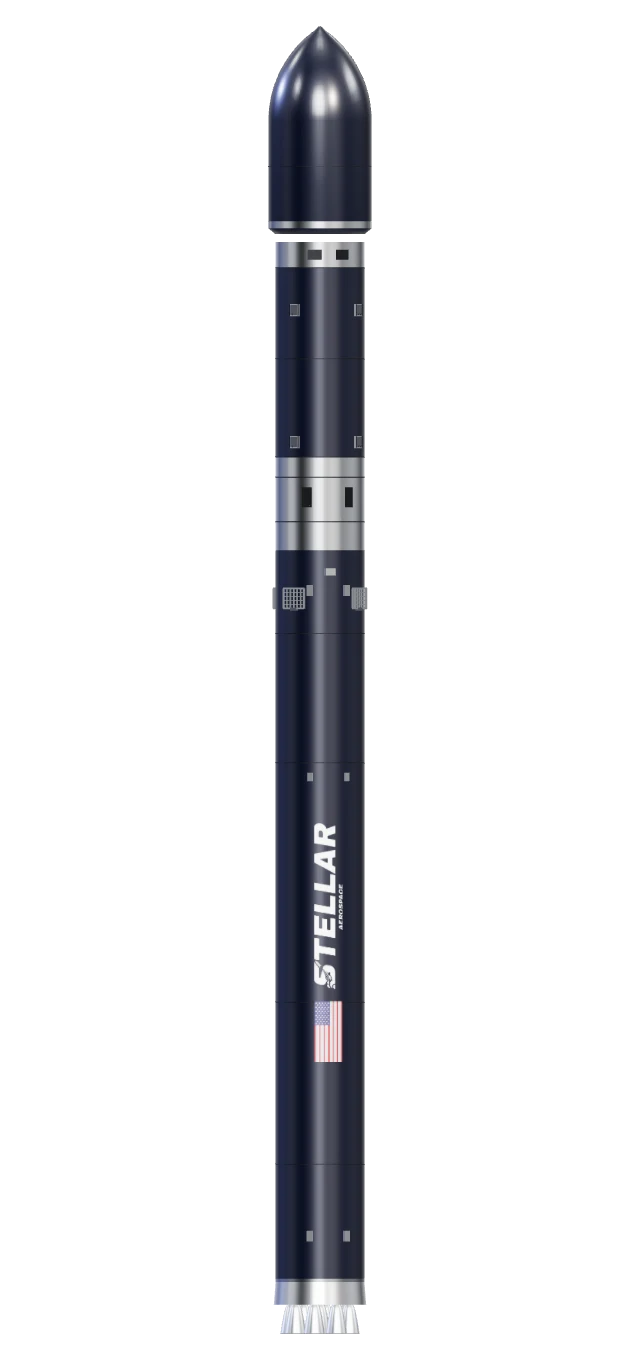
Phase 2 · The Orbital Demonstrator · Complete by Late 2029
Spark is a smaller version of Lightning, our commercial rocket. It can put up to 100 kg into orbit, but it carries no paying customers. Spark is where we can afford explosions and crashes while we perfect every Lightning system and make them work together.
Lightning at a size we can afford to break. A two-stage rocket that can carry up to 100 kg to Low Earth Orbit. Spark flies no paying customers: it is where we expect explosions and crashes while we perfect every Lightning system and make them work together.
Phase 2 Demonstrator
02 / 10
Nine Firebird Engines
Stage one carries nine Firebird engines in the same layout Lightning uses with Phoenix. Building and flying a nine-engine cluster at this size teaches us how to produce, test and control a cluster before the engines get bigger.
9 × Firebird
03 / 10
Pumps Driven by Batteries
Firebird burns liquid methane and liquid oxygen, cools itself with its own fuel, and feeds its propellants with electric pumps powered by a LiPo battery bank. Like every Stellar engine it is 3D printed in Inconel 718 for rapid, simple manufacturing, and with no turbine to develop we can build and test it often.
Electric pump-fed, methalox
04 / 10
Tanks Tested Until They Break
The propellant tanks are welded aluminum 6061. Test tanks are filled with water and chilled with liquid nitrogen, then pressurized until they fail, so our safety margins come from measurements and not only from calculations.
Al 6061, tested to failure
05 / 10
Three More on Stage Two
The second stage flies three vacuum-optimized Firebird engines, with larger nozzles than the sea-level engines on stage one. One engine family across both stages means one production line, one test stand and every firing adding to the same body of data.
3 × Firebird Vacuum
06 / 10
A Fairing That Stays On
Spark flies the hinged fairing Lightning will use. Its halves swing open on hinges at their base, stay attached to the stage, and close again so the fairing comes home and flies again instead of falling into the ocean.
Hinged Fairing
07 / 10
The Chameleon Rack
Up to 100 kg of test payloads ride on a small-scale Chameleon rack with Fly Adapters, the same design Lightning carries at full size. An earlier small-scale version flies first on The Guinea Pig in Phase 1.
Stage one flies back steered by four grid fins, slows on its engines and is caught by the launch tower’s arms, exactly as Lightning’s booster will be. Its guidance software is trained on real flight data from The Guinea Pig.
Tower Catch
09 / 10
Hooked and Netted
Stage two survives reentry behind a custom-made PICA ablative heat shield on the windward side of the stage and its fairing, clicked in before flight and swapped for a fresh one after landing. It then glides home under a steerable parafoil. Over the recovery arena it lowers a hook that snags an arresting cable, the parafoil is cut away and shock absorbers stop the stage above the net. Cold gas thrusters, used only during landing, trim for crosswind on the approach, hold a hover after the catch, then taper off to set the stage softly in the net. The arena works from eight directions, whatever the wind.
Parafoil, Cable and Net
10 / 10
Built to Become Lightning
Every system here carries straight into Lightning. Phoenix replaces Firebird, the payload grows from 100 kg to 2,750 kg, and the recovery and turnaround we practice on Spark become a twice-weekly launch service.
Next: Lightning
What Spark Proves
A $25 million program budget covering research and development, hardware and room for many failures, across every system that the 2,750 kg-to-orbit Lightning will need. Each system is chosen because Lightning needs it, so a successful Spark flight is a direct step toward commercial service.
SystemOn SparkProves for Lightning
Engines9 + 3 FirebirdCluster production and control for 9 + 3 Phoenix
StructuresWelded Al 6061Tank design data from tests to failure
Payload100 kg test payloadsThe same rack and Fly-series adapters at full size
Booster recoveryTower CatchThe same catch at full size
Upper stage recoveryParafoil, Cable and NetThe same arena landing
One Engine Family
Big Piggy
Phase 1
Kerolox: pressure-fed kerosene and liquid oxygen with an ablative liner in a 3D-printed Inconel shell. Simple, cheap and built to get The Guinea Pig to 100 km.
Firebird
Phase 2
Methalox, electric pump-fed, regeneratively cooled and 3D printed in Inconel 718. Nine sea-level and three vacuum-optimized per Spark.
Phoenix
Phase 3
Our largest engine. Methalox, electric pump-fed, regeneratively cooled and 3D printed in Inconel 718 at fleet volume. Nine sea-level and three vacuum-optimized per Lightning.
Every Stellar engine is 3D printed in Inconel 718, and each generation is larger than the last. Spark figures are design targets and will be updated as Phase 1 flight data comes in.
Next: Lightning
See the full-size rocket Spark is building toward, and how a mission flies from booking to recovery.