
Phase 1:
The Guinea Pig

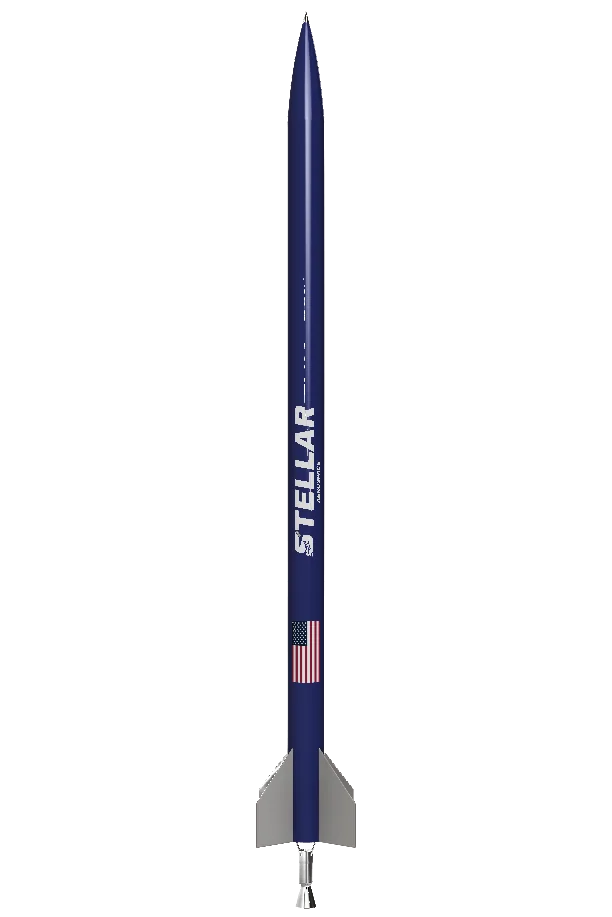
Our first rocket. A 600 kg, liquid-fueled suborbital vehicle on our Big Piggy kerosene and liquid oxygen engine, built to fly to at least 100 km, the edge of space, in late 2027. The $500,000 program budget covers research and development, about $150,000 of hardware, and room for failures along the way. It exists to test, on a real flight, the systems every later Stellar rocket depends on.

See the Specs
The Guinea Pig suborbital rocket

Why Fly This
First

An orbital rocket is too expensive to learn on. The Guinea Pig gives us the same kinds of answers for a fraction of the cost: real engine, real flight, real data. The name is the point. It is the test subject for everything that follows.

When it reaches space, The Guinea Pig will be the first student-built liquid-fueled rocket to get there.

Turn Simulations into Flight Data

Every later vehicle is designed in our own trajectory and engine simulations. A real flight to 100 km tells us exactly where those models are right and where they are wrong, before we design an orbital rocket on top of them.

Fly the Guidance and Control First

The Guinea Pig carries our flight computers, telemetry, guidance and engine steering (thrust vector control) through supersonic, high-heat flight. Spark’s landing software is then trained on this real data.

Prove the Payload System Early

It flies a small-scale version of the Chameleon payload rack and its click-on adapter, along with the software that arranges payloads and shows where each one mounts. The same design scales up on Spark and Lightning.

Make Engines Cheaper

Big Piggy is 3D printed in Inconel 718 for rapid, simple manufacturing and has been through more than 63 design iterations. Our goal is to bring the cost of an engine from over $100,000 down to around $15,000, the same approach that lets us print Firebird and Phoenix engines at fleet scale.

Inside
The Guinea Pig

The Guinea Pig vehicle design
Vehicle design targets
EngineThe Big Piggy
Height8.35 m
Diameter30.48 cm
PropellantRP-1 / LOX
Wet Mass600 kg
Dry Mass300 kg
Minimum Apogee100 km
Goal Apogee~150 km
Simulated Apogee112.9 km (103 to 124.2 km)
Burnout Velocity4,961 km/h (Mach 4.67)
Average Specific Impulse265 s
Vacuum Specific Impulse300 s
Chamber Pressure40.4 bar
Burn Time Target30 s
Sea-Level Thrust23.7 kN
Peak Acceleration8.2 g
Total Impulse Target781,930 N·s
Peak Mass Flow10 kg/s

Where the $500K Goes

The Phase 1 program budget, line by line. This is the round we are raising now.

Team Wages
$170K to $215K20 to 25 people at about 10 hours a week, including payroll tax
Flight and Test Hardware
$150KVehicle, Big Piggy engines, test stand and ground systems, with spares for failed tests
Insurance
$35K to $50KLiability coverage for engine testing and launch
Workshop Lease
$24KAbout $2,000 a month in Champaign-Urbana, Illinois, for 2027
Reserve
$60K to $120KUnallocated margin for schedule slips and cost growth
Phase 1 total, 2027
$500,000

Estimates for the full 2027 Phase 1 program. The itemized lines come to about $380,000 to $440,000; the rest of the $500,000 target is held as reserve.

Next:
Spark

The Guinea Pig’s data flows straight into Spark, our orbital demonstrator with 9 + 3 Firebird engines and a 100 kg payload.

Explore Phase 2