
01 / 08
Built and Refueled in Orbit
The Shuttle is assembled in Earth orbit and never lands. A tanker docks and fills it with liquid hydrogen before each trip.
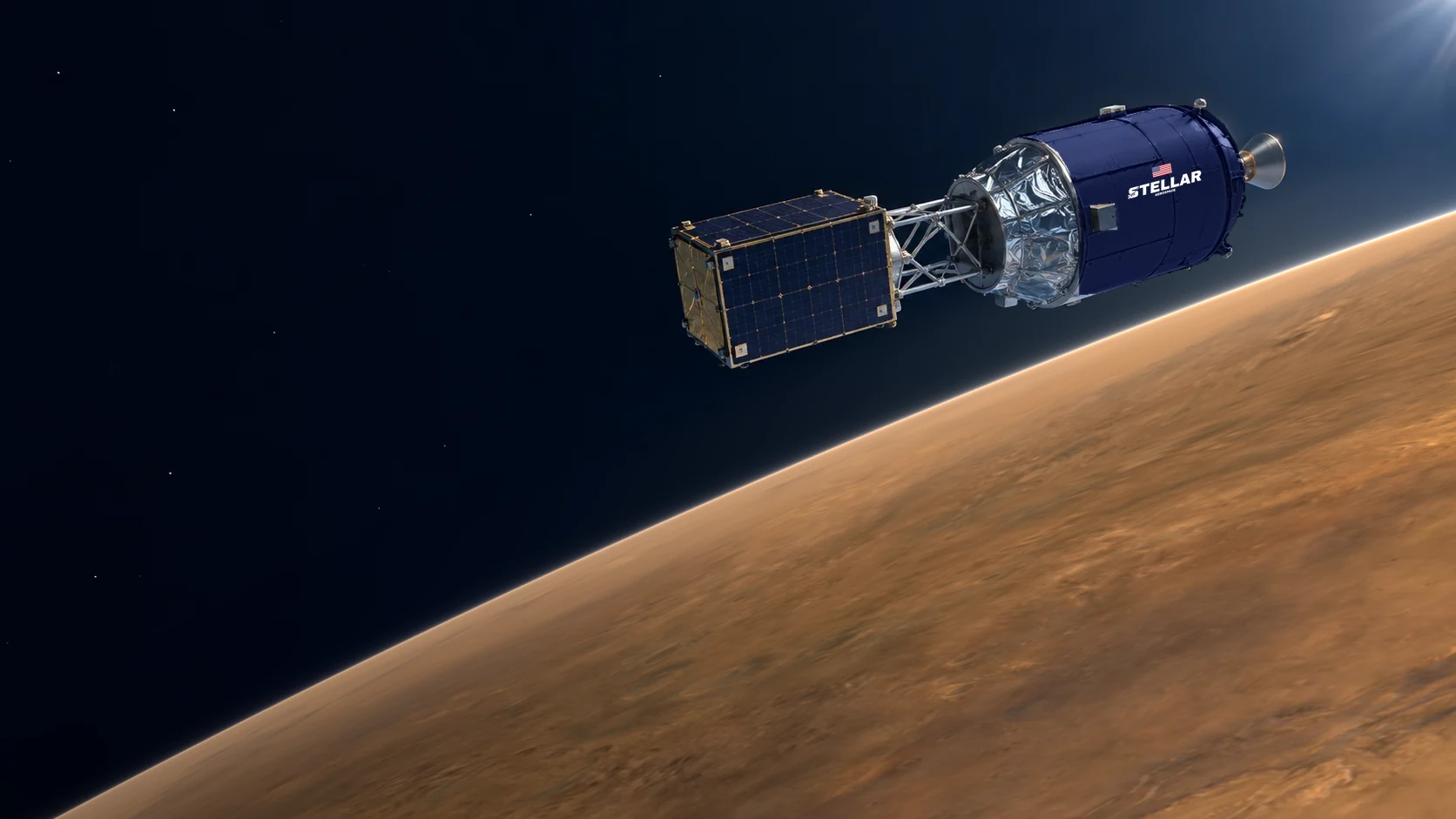
A future concept for a reusable nuclear thermal propulsion spacecraft, built and refueled in Earth orbit, that cuts the trip to Mars to about three months.
Learn MoreLoading the vehicle…
The Shuttle is assembled in Earth orbit and never lands. A tanker docks and fills it with liquid hydrogen before each trip.
A nuclear thermal rocket heats hydrogen to very high temperature, giving roughly twice the efficiency of the best chemical engines.
That efficiency buys a faster trajectory, cutting the trip to about three months and reducing radiation exposure, crew fatigue and isolation.
The Shuttle captures into Mars orbit with its crew capsule docked at the front.
The crew capsule undocks, enters the atmosphere behind its heat shield and lands propulsively on the surface.
After the surface stay, the same capsule lifts off, climbs back to orbit and redocks with the Shuttle.
The Shuttle carries the crew back to Earth orbit.
The capsule re-enters and lands on Earth under parachutes. The Shuttle stays in orbit to be refueled for its next trip.
Chemical rockets take about nine months to reach Mars. Longer trips mean more radiation exposure, more supplies and more risk for the crew, and most plans throw the spacecraft away afterward.
A reusable nuclear thermal spacecraft that stays in space, is refueled in orbit and cuts the trip to about three months. One capsule lands on Mars, returns to orbit, rides home and lands on Earth.
A spacecraft that lives in orbit needs a steady supply of propellant, crew and cargo from the ground. Cheap, frequent launch is that supply line, and it is what we are building first.
Early-stage concept: no validated design or performance is claimed, and we are seeking feasibility input and advisors. Future concept. Illustrative animation. Early-stage concepts under study. Not a commitment to build or sell any product.
We welcome advisors and high-level feasibility discussions. These concepts are not a commitment to build or sell a product.
Advisor Enquiries